Architecture
A decision plane between intent and action
At each decision point, Memrail receives context, selects the right action from policy, and produces a full audit trace.
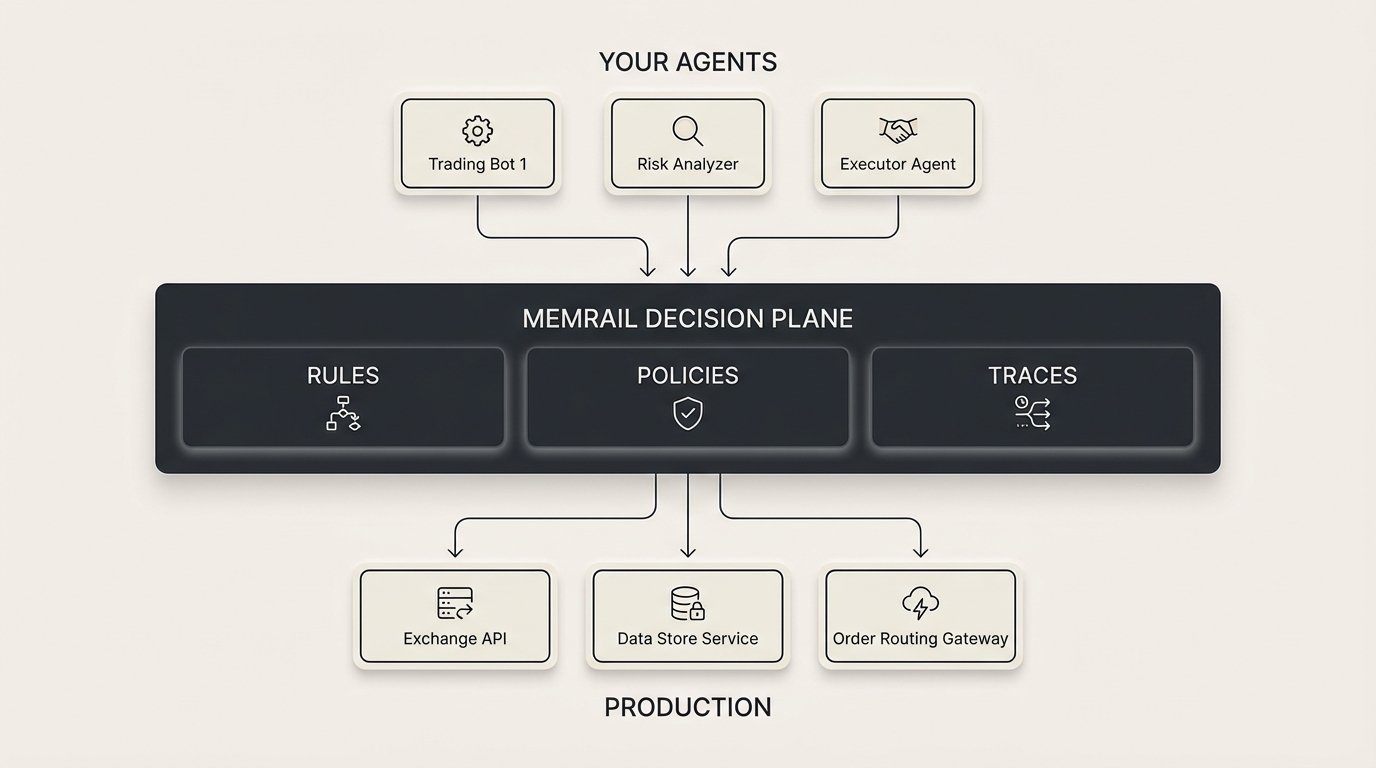
Memrail is decision infrastructure. It sits in the execution path between intent and action - and makes binding decisions about what should happen.
Components
At every decision point, Memrail selects the right action from policy given context.
Learn moreKnow which rules can actually fire, which actions can actually execute, and where the gaps are.
Learn morePromote rules from shadow to canary to active - ship changes without breaking production.
Learn moreReconstruct any decision in seconds: what fired, what was suppressed, and why.
Learn moreMemrail doesn't replace your systems, your models, or your orchestration. It governs them.
Architecture
At each decision point, Memrail receives context, selects the right action from policy, and produces a full audit trace.
By Design
Same context, same decision. Every time.
The execution layer evaluates. It does not hallucinate.
Works with any model, any agent framework, any orchestrator.
Grows linearly with decision points, not exponentially with interactions.
Questions
Evaluation tools score model outputs after the fact. Memrail resolves decisions before actions reach production. It's the difference between reviewing a test and determining what should happen. Memrail is runtime decision infrastructure — it sits in the execution path and makes binding decisions.
No. Memrail is framework-agnostic. It works alongside your existing LLMs, agents, and orchestration. At each decision point, Memrail selects the right action from policy given context. It adds a decision layer without replacing anything in your stack.
A decision topology map, domain analysis, controlled comparison of current vs. governed behavior, sample decision traces, and an integration roadmap.
Memrail sits at your decision points - API handlers, agent loop steps, event handlers, background jobs. At each decision point it receives context, selects the right action from policy, and returns prescribed actions with full rationale. It integrates via lightweight SDK hooks at invoke points.